
Year Four
Mr Hallam is the teacher in our Year Four class. Our PE days are Monday and Wednesday.
Class Saint
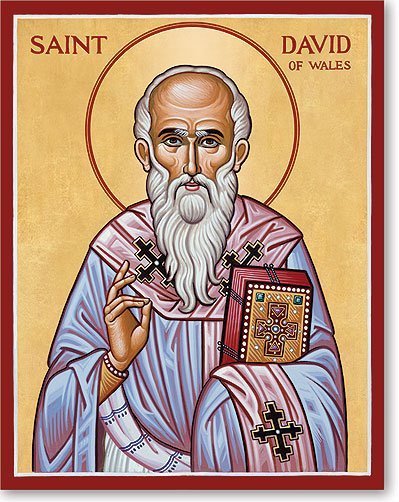 St David. Patron Saint of Wales. Feast day is 1st March.
David was born about 520 near St. Bride’s Bay, Pembrokeshire, Wales. There is very little known about his life. David was the son of a leader named Sant and Non, a woman who later was named a saint.
David became a Christian priest. He then lived on an island for many years to study the Bible.
Once he left the island, David founded a monastery, or religious house, at Mynyw (Menevia) in southwestern Wales. Life at David’s monastery was very strict. The monks who lived there had to work very hard. They were rarely allowed to speak. They ate only bread with vegetables and salt. They drank only water.
David founded many churches throughout southern Wales. He later moved the center of the church government from Caerleon to Mynyw. David died in about 600 in Mynyw.
St David, Pray for us
Autumn Term Curriculum Overview
Maths
Column addition and subtraction
Add and subtract multiples of 100
Compare and order 4-digit numbers
Rounding 4-digit numbers to the nearest 1000, 100 and 10
Know how many 100s, 200s, 500s and 250s, 1000 is composed of
Perimeter
Explore and learn the 3, 6 and 9 times tables
English
The Y4 class text this term is Charlotte’s Web.
We will be learning to:
infer meanings with evidence, build a varied vocabulary, extend sentences using conjunctions, use fronted adverbials, organise paragraphs, punctuate speech, edit writing and make improvements, use semi-colons and summarise ideas.
RE
Creation and Covenant
- The story of Abraham and Isaac
- God’s covenant with Abraham is the foundation of Judaism and Christianity
- The decisions of Abraham and Joseph were informed by the faith in God
Prophecy and Promise
- Describe what a prophet is with Elijah and John the Baptist as examples
- Make links between Isaiah, John the Baptist and the season of Advent
- Know that Christ the King marks the end of the Church’s year
- Make links with the ancestry of Jesus and the Jesse tree
History
Y4 will be studying Anglo-Saxons and Vikings.
Key learning includes:
· Know meaning of BCE and CE
· Anglo-Saxon settlements
· Life in Anglo-Saxon Britain
· Alfred the Great
· Resistance against the Vikings
· Rise of Christianity
Science
Describe the simple functions of the basic parts of the digestive system in humans
Identify the different types of teeth in humans and their simple functions
Design and Technology
Electrical Systems - Simple circuits and switches
Gather information about needs and wants, and develop design criteria to inform the design of products. Generate, develop, model and communicate realistic ideas through annotated sketches, cross-sectional and exploded diagrams. Order the main stages of making. Select and use tools and equipment to cut, shape, join and finish. Select and use materials and components, including construction materials and electrical components. Evaluate their ideas and products against their own design criteria and identify the strengths and areas for improvement in their work. Understand and use electrical systems in their products, such as series circuits incorporating switches, bulbs and buzzers.
PE
Dodgeball
Develop throwing in a target game. Develop dodging skills to avoid being hit. Develop catching within the rules of the game. Think tactically. Compete in a tournament.
Gymnastics
Develop individual and partner balances using apparatus. Perform and land rotation jumps. Develop the straight, barrel, forward and straddle roll. Link actions that flow. Create a partner sequence using actions learnt.
Computing
Creating Media - Photo editing- Manipulating digital images, and reflecting on the impact of the changes and whether the required purpose is fulfilled
Music
Clarinet lessons
Personal Development
Anti-Racism - Unconscious bias. Being anti-racist in our actions. Representation matters. Myth-busting anti-racism.
Me, My Body, My Health - Similarities and differences between people. Self-confidence. Respecting our bodies. Puberty. Changing bodies.