Year Six
Miss Carberry is the teacher in our Year Six class. Our PE days are Monday and Tuesday.
Class Saint
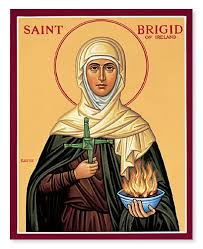 St Brigid. The Patron Saint of Ireland. Feast day is 1st February
St Brigid is best known as being the founder of the first monastery in County Kildare, Ireland. Born in Dundalk in 450 AD, her father was a pagan chieftain of Leinster and her mother was a Christian. She was inspired by St Patrick to spread the word of God around Ireland.
St Brigid, pray for us.
Autumn Term Curriculum Overview
Maths
Calculate missing parts
Solve addition and subtraction calculations
Read and write numbers up to one million
Round seven-digit numbers to the nearest million and hundred thousand
Add and subtract numbers with up to seven digits
Area and perimeter
English
The Y6 class text this term is War Horse.
Key learning includes:
Make predictions and inferences when reading with evidence
Simple, compound and complex sentences
Speech punctuation
Expanded noun phrases
Semi-colons
Edit and improve writing
Summarise ideas
Parenthesis—brackets, dashes
RE
Creation and Covenant
- Explain the second Creation story
- Understand ‘original sin’
- Sacrament of Baptism
- In Jesus, a new covenant is made
Prophecy and Promise
- The importance of women in salvation history
- Mary is the fulfilment of the Old Testament promises
- Understand how and why the Magnificat prayer forms radical expectations of the Messiah
- Understand the lives of individual women today who are responding to God’s call
|
|
History
Y6 will be studying Ancient Civilisations.
Key learning includes:
· Periods of Ancient Greece
· Political and social change has an impact on society
· Alexander the Great
· Fact and bias
· Cleopatra
Science
Associate the brightness of a lamp or the volume of a buzzer with the number and voltage of cells
Compare and give reasons for variations in how components function, including the brightness of bulbs, the loudness of buzzers and the on/off position of switches
Use recognised symbols when representing a simple circuit in a diagram
Design and Technology
Electrical Systems - More complex switches and circuits
Use research to develop a design specification. Generate and develop innovative ideas. Communicate ideas through annotated sketches, pictorial representations or diagrams. Formulate a step-by-step plan. Competently select and accurately assemble materials, and securely connect electrical components. Create and modify a computer control program. Continually evaluate and modify the product to match the initial design specification. Test the system to demonstrate its effectiveness. Investigate famous inventors. Understand and use electrical systems in their products. Apply their understanding of computing to program, monitor and control their products.
PE
Basketball
Demonstrate attacking skills. Move into and create space. Choose when to pass and when to dribble. Use appropriate defensive techniques. Develop shooting techniques. Apply rules and tactics to a tournament.
Gymnastics
Develop the straddle, forward and backward roll. Develop counterbalance and counter tension. Develop jumps and explore the effect of height. Use flight from hands to travel over apparatus. Create a group sequence.
Computing
Computing systems and networks - Communication and Collaboration
Explain the importance of internet addresses. Recognise how data is transferred across the internet. Explain how sharing information online can help people work together. Evaluate different ways of working together online. Recognise how we communicate using technology.
Music
Rhythmic devices and structure
Explore time signatures - get a feel for 6/8 rhythms and learn to identify changes in time signature and musical style. Explore rhythmic poems and songs. Experiment with vocal and instrumental effects by varying articulation, dynamics and timbre and learn to identify these features when listening to each other perform. Listen to rhythms from around the world such as djembe drumming from West Africa, Latin American rhythms such as tango, salsa and samba and Konnokal from South India. Learn to play polyrhythms and experiment with creating different polyrhythmic textures. Capture rhythmic ideas in a musical structure.
French
Greetings, days of the week, how people are and what they are like
Personal Development
Anti-Racism - Unconscious bias. Being anti-racist in our actions. Representation matters. Myth-busting anti-racism.
Me, My Body, My Health - Similarities and differences between people. Types of families. Self-confidence. Girls' bodies and changes during puberty. Boys' bodies and changes during puberty. Healthy lifestyles.